A six-phase methodology led by PMP-certified Solutions Engineers. 300+ successful go-lives across Europe.
What this means for your project
From contract signature to go-live, your project is owned by a single Batch Solutions Engineer who holds PMP certification and acts as your dedicated project manager. They do not hand off to a separate support team mid-project. They are accountable for scope, timeline, and delivery quality until the formal closure meeting.
The methodology below is structured around six phases, each with defined entry criteria, named deliverables, and a formal gate before the next phase opens. Every deliverable produced during the project is yours to keep.
Total typical timeline: 8 to 14 weeks end-to-end. For push-only or single-channel scopes, accelerated programmes of 6 weeks are achievable.

The Implementation Project Governance
Phase 1: Initiation
Duration: 3 to 5 business days
Your team: Project sponsor, CRM lead, technical lead (mobile or web), IT or data representative
Batch team: Solutions Engineer (project manager) + Account Manager
Deliverables: Project charter signed by both parties, RACI matrix, shared project workspace, kick-off meeting minutes with open items log
Gate criterion: All stakeholders confirmed and available; project charter countersigned
The kick-off meeting establishes the risk baseline: resource availability, existing technical constraints, and external dependencies that could affect the timeline. Any risk identified at this stage is logged immediately with a named owner.
Phase 2: Scope definition
Duration: 1 to 2 weeks
Your team: CRM team, frontend and backend developers, data or analytics owner
Batch team: Solutions Engineer + Data Architect where data platform connections are in scope (Snowflake, Hightouch, Piano, Databricks)
Workshops: Use case mapping (1 to 2 sessions of 2 hours each), data model and event taxonomy review, SDK integration planning, third-party connector scoping
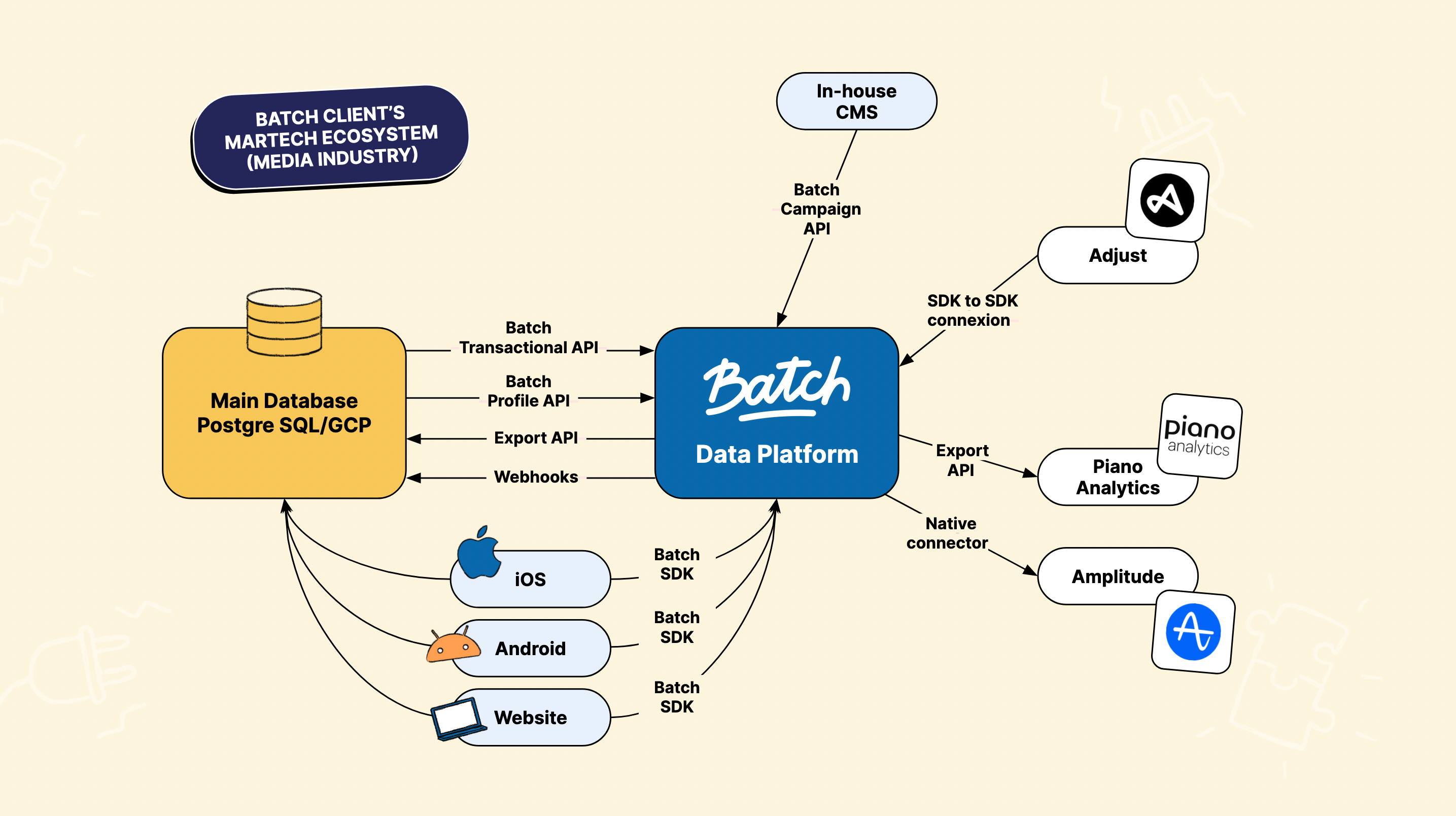
Deliverables: Functional specification, data mapping plan, integration architecture diagram, project plan with named owners and dates for every milestone
Gate criterion: Scope document approved by both teams; timeline validated against your resource calendar
Scope changes after this phase close are managed as formal change requests: assessed for timeline and cost impact, approved in writing by both sides before any work begins. This is how your go-live date stays protected.

Phase 3: Technical implementation
Duration: 3 to 6 weeks depending on scope
Your team: Frontend or mobile developers for SDK integration, backend or data engineers for pipeline connections
Batch team: Solutions Engineer coordinates; technical support available with a 4-hour response SLA on implementation blockers
Deliverables: SDK integrated across iOS, Android, and web; data pipelines connected and validated; audience segments confirmed; campaign templates configured in the Batch dashboard
Governance:
Weekly project committee (30 minutes): progress vs. plan, open risks, decisions required
Monthly steering committee (45 minutes): alignment on strategic direction with key stakeholders, review of major changes and critical risks, decision-making on key topics
Written status report sent by your Solutions Engineer every two weeks regardless of project status
Gate criterion: All scope items built and unit-tested; no critical issues open in the shared tracker
Your Solutions Engineer monitors the shared issue tracker continuously between scheduled meetings. Blockers are raised as they surface, not held for the next committee.
95%+ of Batch implementation projects are delivered within the contractually agreed go-live window. The two primary drivers: scope locked at Phase 2, and blockers escalated within 24 hours of identification.
Phase 4: Testing and validation
Duration: 1 to 2 weeks
Batch acceptance testing: End-to-end validation of all technical integrations: event tracking accuracy, audience segmentation logic, push, email, SMS, and in-app delivery across all channels and target locales
Your business validation: Campaign flows, journeys, and data outputs mapped against the agreed use cases; brand and compliance requirements confirmed
Multilingual validation: For multi-language deployments, each locale is tested independently. AI Translate outputs are reviewed against your terminology glossary and brand voice guidelines
Training: Live dashboard training session (2 hours) for CRM and marketing users, covering campaign creation, journey builder, and reporting. Session is recorded and provided to your team
Gate criterion: Zero critical defects open; business validation signed by your CRM lead; training completed
The acceptance test plan is written during Phase 2 and references your specific use cases. There are no surprises at this stage about what constitutes a successful outcome.
Phase 5: Go-live
Duration: 1 to 3 business days
Deployment: Production deployment executed by your technical team, supported in real time by your Solutions Engineer
Hypercare monitoring: Batch monitors delivery rates, event ingestion, and error logs for one week post-launch. Any anomaly triggers immediate notification to your team
Rollback plan: Rollback procedure documented and tested before go-live date, not drafted reactively
Gate criterion: All KPIs from the acceptance test plan confirmed in production; no critical incidents open after the 48-hour monitoring window
Your Solutions Engineer remains accountable through the 48-hour hypercare window before formally handing over to your Customer Success Manager.

FizzUp Tech Feedback - Batch Successful Implementation
Phase 6: Project closure
Duration: 3 to 5 business days
Deliverables: Full project documentation archive: functional specs, test plans, decisions log, meeting minutes, as-built technical summary
Lessons learned: Joint retrospective covering scope delivered vs. agreed, timeline adherence, and any process improvements identified. Shared with your team.
Transition: Formal briefing of your Customer Success Manager covering account context, technical configuration, open items, and your strategic roadmap
Every document produced during the project is archived and handed over to you at closure. Your team has full visibility into what was built and why.
Timeline summary
Phase 1 → Initiation (3–5 days): Signed project charter + RACI
Phase 2 → Scope definition (1–2 weeks): Approved functional spec + project plan
Phase 3 → Technical implementation (3–6 weeks): Integrated SDK + configured campaigns
Phase 4 → Testing & validation (1–2 weeks): Signed acceptance report + trained users
Phase 5 → Go-live (1–3 days): Live in production + 48h hypercare
Phase 6 → Project closure (3–5 days): Full documentation archive handed over
What your team needs to bring
The most common cause of delayed go-lives is not technical complexity — it is client-side resource availability. To hit an agreed timeline, the following need to be confirmed before Phase 1 closes:
A named technical lead with authority to make integration decisions and at least 30% availability during Phases 2 and 3
Access to your data layer — event schema, user identifiers, and the team responsible for data pipelines. Batch cannot build the integration without this
A CRM owner who can validate campaign logic and sign off on the acceptance test plan in Phase 4
Legal and security review completed or in parallel — not initiated after go-live is confirmed. DPA and data flow documentation are provided by Batch in Phase 1
Further reading
For a detailed breakdown of the technical implementation phase, including SDK integration patterns, data mapping, and connector architecture: [BlogPost] Omnichannel CRM Platform: the Batch technical implementation step-by-step guide
To scope your implementation and get a timeline estimate, contact your Account Manager or reach us at sales@batch.com.
Selma Bennamane
Solution Architect @ Batch (Project Management Professional Certified)
Follow us


The CRM Newsletter
Subscribe to get the latest news in your inbox!